AI Is Commoditizing Intelligence — Now Enterprises Must Compete on Adaptation

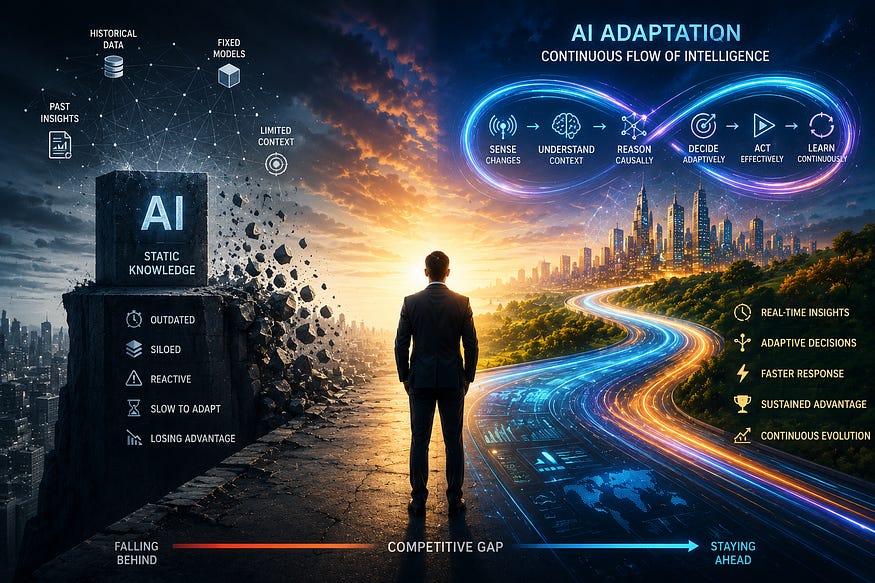
For decades, enterprises competed on access to intelligence.
Organizations invested heavily in:
better analysts, larger consulting engagements, proprietary data, institutional expertise, forecasting systems, specialized decision-making capabilities.
Intelligence itself was scarce.
And scarcity created competitive advantage.
But AI is now changing that equation fundamentally.
Large Language Models, generative AI systems, autonomous agents, and rapidly advancing reasoning architectures are making analytical intelligence increasingly accessible to everyone.
The ability to:
generate insights, analyze information, produce recommendations, synthesize knowledge, reason across domains, and automate complex cognitive tasks
is rapidly becoming commoditized.
This may become one of the most important shifts in modern enterprise competition.
Because once intelligence becomes broadly accessible, intelligence alone no longer creates durable advantage.
The competitive frontier moves somewhere else entirely.
And that “somewhere else” is operational adaptation.
The End of Static Competitive Advantage
Most enterprises were built for relatively stable environments.
Organizations optimized around:
efficiency, predictability, repeatability, standardization, long planning cycles, and fixed operational assumptions.
Traditional enterprise strategy assumed markets moved slowly enough for organizations to establish durable positions.
But modern operating environments no longer behave that way.
Today:
competitors adapt continuously, consumer behavior shifts rapidly, regulations evolve dynamically, AI capabilities diffuse almost instantly, and operational conditions constantly change.
As a result, static optimization is becoming increasingly fragile.
The organizations that lead the next decade will not necessarily be those with the most intelligence.
They will be those capable of adapting operationally faster than the environment changes around them.
That is a fundamentally different competitive model.
AI Is Accelerating Competitive Compression
One of the least discussed consequences of AI is that it accelerates strategic imitation.
When intelligence becomes widely available:
best practices spread faster, advantages erode more quickly, operational inefficiencies become easier to identify, and decision-making capabilities become democratized.
Historically, organizations could maintain advantage because sophisticated analysis itself was difficult.
Now increasingly:
everyone has access to advanced reasoning systems.
This means enterprises can no longer rely primarily on:
information asymmetry, analytical exclusivity, or static operational models.
The strategic challenge is no longer:
“Can the organization become intelligent?”
The real challenge is:
“Can the organization continuously adapt under changing conditions?”
That distinction changes everything.
Why Operational Adaptation Becomes the Real Enterprise Capability
Most enterprise AI systems today still focus heavily on:
automation, workflow acceleration, task optimization, content generation, and predictive analytics.
These capabilities matter.
But they primarily optimize execution within existing assumptions.
The next era of enterprise AI will require something much more difficult:
continuous operational adaptation.
That means enterprises must increasingly build systems capable of:
monitoring changing environments, understanding shifting causal dynamics, evaluating intervention consequences, adjusting operational strategies in real time, incorporating contextual reasoning, and aligning decisions with evolving institutional constraints.
This is not simply an AI problem.
It is an operational intelligence problem.
And operational intelligence is fundamentally different from static intelligence.
Static intelligence asks:
“What is the correct answer?”
Operational intelligence asks:
“What action remains valid as the environment changes?”
That is a far more difficult challenge.
Why Intelligent Systems Alone Are Not Enough
Modern AI systems are already remarkably capable.
They can retrieve knowledge, summarize information, coordinate workflows, and generate highly fluent reasoning narratives.
But real-world competitive environments are not static information systems.
They are adaptive systems.
And adaptive systems require:
continuous recalibration, causal understanding, contextual interpretation, consequence-aware intervention, and dynamic strategic adjustment.
This is where many current AI architectures begin to struggle operationally.
Because generating intelligent outputs is not the same thing as sustaining competitive adaptation.
An enterprise may possess highly advanced AI systems while still remaining operationally rigid.
And in rapidly evolving environments, rigidity becomes vulnerability.
The Rise of Adaptive Enterprises
The next generation of leading enterprises will likely not be defined by:
who has the largest models, who deploys the most agents, or who automates the most workflows.
They will be defined by:
who adapts operationally the fastest, who learns continuously from changing conditions, who integrates causal and semantic reasoning into decisions, and who evolves institutional behavior under uncertainty.
This represents the transition from:
intelligent enterprises
to:
adaptive enterprises.
That transition may become one of the defining strategic shifts of the AI era.
The Emerging Operational Intelligence Stack
The future enterprise AI architecture will likely evolve far beyond:
LLMs → Agents → Automation
Toward systems built around:
reasoning, causal adaptation, semantic interpretation, governance-aware decision intelligence, human operational oversight, and continuous strategic recalibration.
In other words:
AI systems will increasingly become part of operational evolution infrastructure — not merely productivity tooling.
This is why many organizations are beginning to discover that AI maturity is not simply about deploying copilots or agents.
It is about progressing toward adaptive operational intelligence.
That progression often evolves through multiple stages:
assistive AI, operational AI, strategic AI, systemic AI, and ultimately toward institutional intelligence capable of continuous learning and governance-aware adaptation.
This is not merely a technology transformation.
It is an organizational transformation.
Building the Adaptive Enterprise
The enterprises that succeed in the next era will likely be those capable of:
continuously recalibrating decisions, integrating causal and semantic reasoning, operating under uncertainty, aligning AI with governance realities, and evolving operationally faster than competitors can react.
Because in the age of AI, intelligence increasingly becomes accessible to everyone.
But adaptive operational evolution remains extraordinarily difficult.
And that may become the defining enterprise capability of the next decade.